April 1, 2026 · 14 min read
Why Most Bali Airbnb Hosts Still Run Their Operation Through WhatsApp Groups (And What the Smart Ones Do Instead)
By Masaya Team
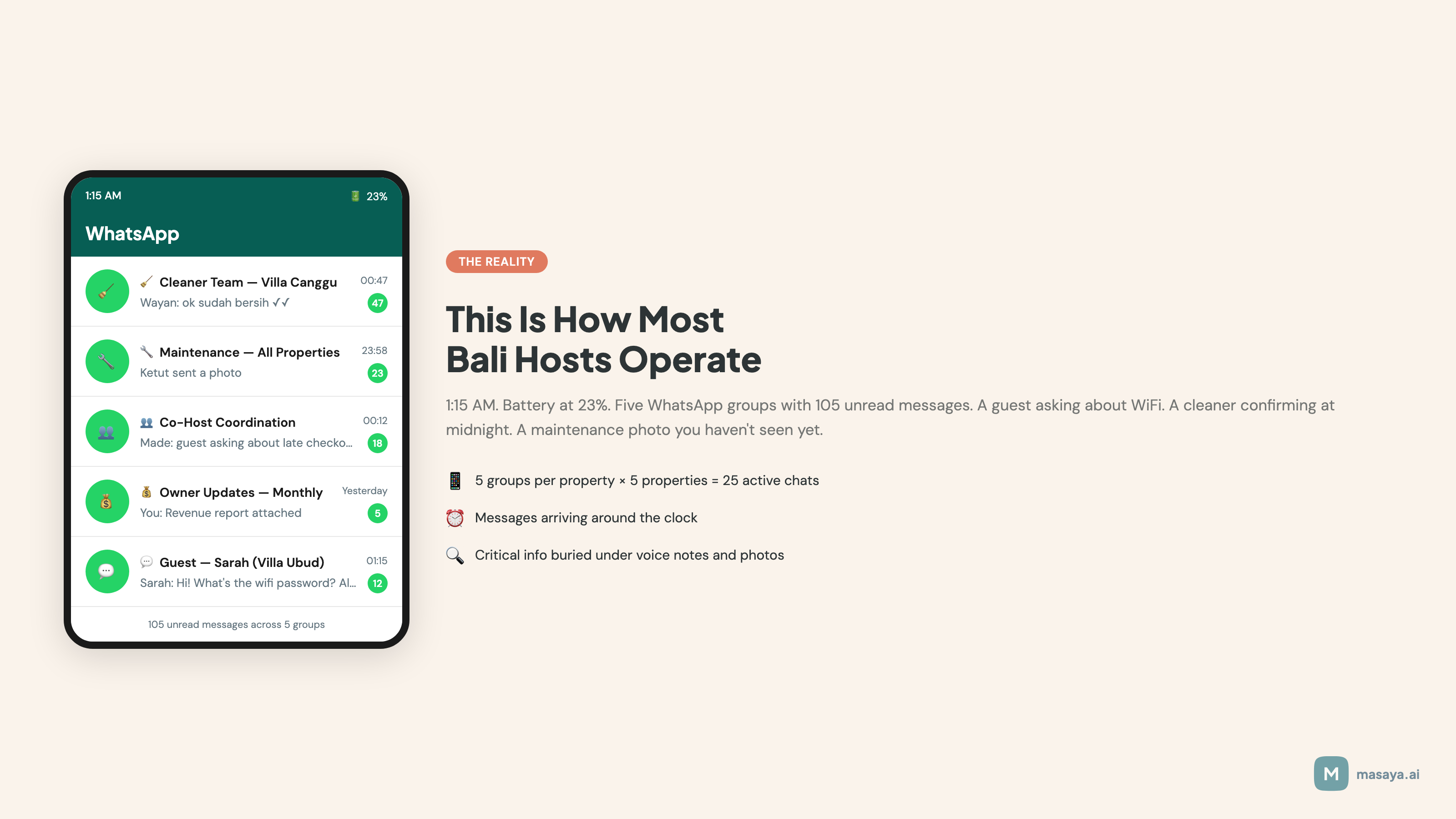
At some point, a lot of Bali hosts end up running a mini hotel through five WhatsApp groups and pure force of will.
One group for cleaners.
One for maintenance.
One with the co-host.
One with the owner.
And one direct thread with the guest who somehow still asks for the Wi-Fi password after check-in.
It feels normal because WhatsApp is normal in Indonesia. WhatsApp penetration in Indonesia sits at roughly 91%, making it the default communication layer for daily life and business alike. So when a host starts managing 1 or 2 villas, using WhatsApp for everything does not feel like a workaround.
It feels like the system.
Until it doesn't.
The cleaner misses a same-day turnover because the booking screenshot got buried.
The maintenance guy shows up, but the cleaner doesn't.
The guest lands early, but nobody updated the group.
The owner in Sydney wakes up to 84 unread messages and no idea whether the villa is actually ready.
That is the Bali hosting trap in one sentence: WhatsApp works beautifully as a communication tool, and terribly as an operating system.
WhatsApp is not the problem. Using it as your dispatch board, audit trail, calendar, SOP repository, and escalation system all at once is the problem.
If you manage one property in Canggu and live 15 minutes away, you can get away with this for a while.
If you manage 3 properties, you start feeling the cracks.
If you manage 5, the WhatsApp group becomes the bottleneck that runs your life.
This is especially true in Bali, where many operators are remote owners living in Australia, Singapore, Europe, or Jakarta while their villas run on local cleaners, freelance maintenance help, and a co-host holding the threads together.
And now there is another layer: compliance. Bali's short-term rental rules are tightening, with operators increasingly having to coordinate licensing, registration, guest reporting, and admin tasks on top of daily guest operations. That means one more thing getting dropped into the same message stream as "AC leaking" and "guest asking for late checkout."
The result is predictable:
messages everywhere, ownership nowhere.
Why WhatsApp Groups Feel Fine at 1-2 Properties
WhatsApp groups do solve a real problem early on.
They are fast.
Everyone already uses them.
No training required.
No login friction.
No one has to learn a new app.
For a host with 1 or 2 properties, that matters.
A booking comes in.
You drop the dates in the cleaner group.
You send the gate code to the guest.
You ping the maintenance guy if the hot water acts up.
Done.
That is why so many Bali hosts stay here longer than they should. The system is just good enough to survive the first stage.
But surviving and scaling are two different things.
The moment your operation depends on memory, screenshots, and someone being awake at the right time, you are not running a system.
You are running live human routing.
That is why so many hosts describe the same workflow in STR communities:
- "I screenshot my calendar and text my cleaner the dates manually."
- "I just send my cleaner a text message with the booking info when it comes in, day in and day out."
- "Take a screenshot of each month's calendar and message them the photo, then adjust as needed if new reservations come up."
That works when bookings are light and changeovers are simple.
It breaks the moment the calendar gets dynamic.
Back-to-back stays.
Early arrivals.
Late departures.
A guest who extends by one night.
A cleaner who thought checkout was 11 but the next guest arrives at 1.
The real danger of WhatsApp groups is not that they fail immediately. It's that they fail slowly enough to look normal.
The 5 Failure Modes of the Bali WhatsApp Group Setup
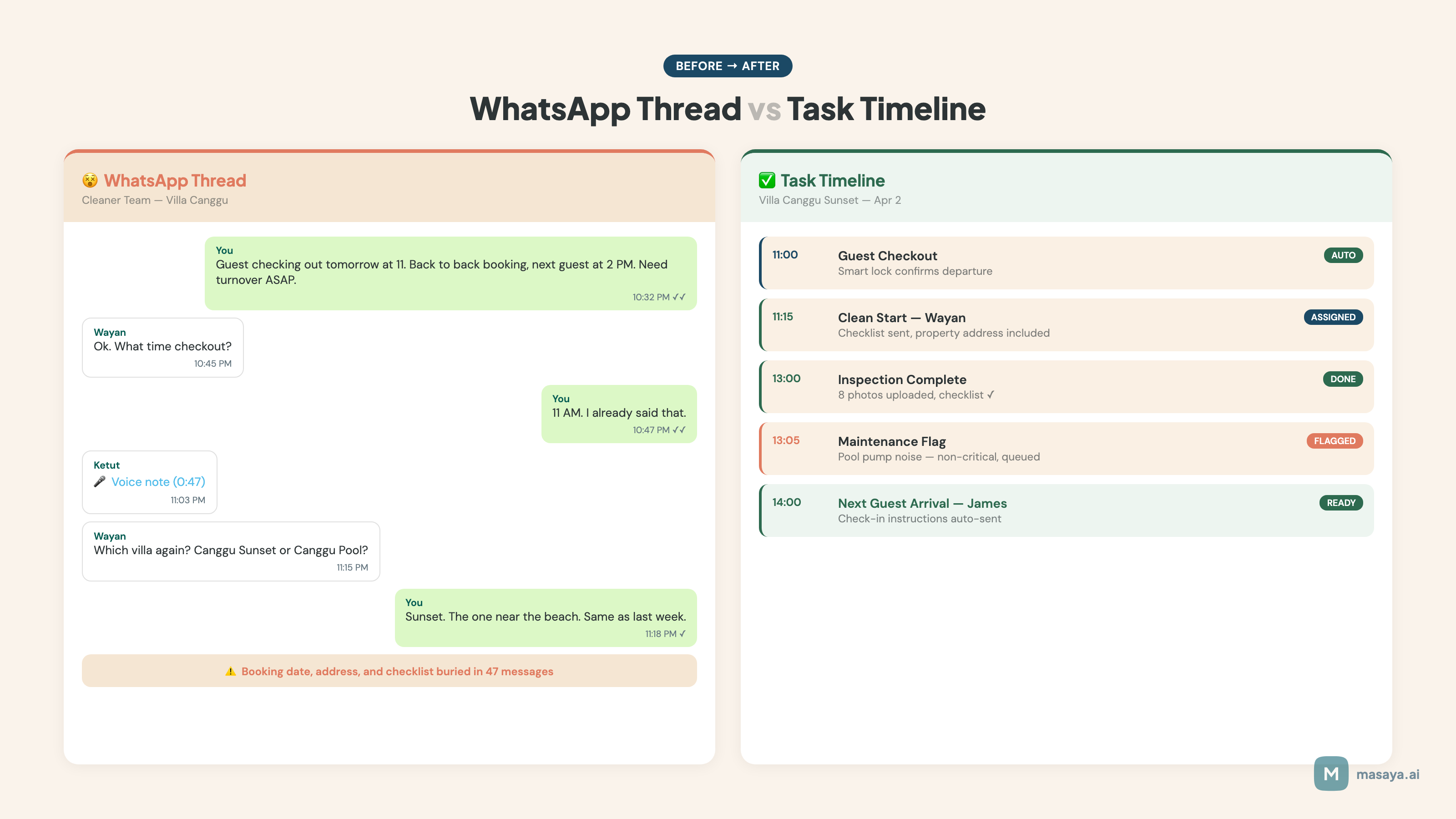
1. Messages Get Buried, So Critical Tasks Become Guesswork
In most Bali host setups, the same group handles everything:
- tomorrow's cleaning
- missing towels
- guest asking for airport pickup
- owner asking about occupancy
- maintenance photo of a broken shower head
- someone replying with a thumbs up
- five unrelated voice notes
That is not a workflow.
That is a feed.
And feeds are terrible at telling people what is still open, who owns it, and whether it got done.
If a cleaner misses one message in a 70-message day, the host pays the price.
Not the chat.
The host.
That is why hosts say things like:
"My listing has back-to-back bookings so the cleaner has no idea when the guest arrives and leaves."
Not because the cleaner is bad.
Because the information architecture is bad.
2. There Is No Accountability Chain
In a WhatsApp group, everybody saw it.
Which often means nobody owns it.
Someone writes:
"Can someone confirm Villa Satu was cleaned before 3 PM?"
A few people read it.
One person reacts.
Another says "On it."
But where is the record?
Who is accountable if it doesn't happen?
What is the escalation path?
Where is the proof?
Hosts often confuse visibility with control.
They are not the same.
Just because a message was posted does not mean a task was assigned, accepted, completed, or verified.
When your property is running on chats instead of roles, every operational miss turns into detective work.
Who saw the message?
Who replied?
Who thought someone else had it?
That is a horrible way to run hospitality.
Because hospitality is won or lost in handoffs.
3. Time Zone Gaps Turn Small Issues Into Night Dramas
This is where Bali becomes uniquely messy.
A huge share of villa owners are not physically in Bali.
They are in Perth.
Melbourne.
Singapore.
Berlin.
Amsterdam.
Or splitting time between places.
So now your operations depend on a local team in Bali, guests arriving on international schedules, and an owner trying to manage from a different time zone through WhatsApp notifications.
This is chaos disguised as flexibility.
The owner goes to sleep.
The guest lands.
The guest cannot find the property.
The co-host forwards it to the cleaner group.
The cleaner is offline.
The maintenance guy responds in the wrong thread.
The owner wakes up to a chain of messages that starts with "Guest arrived" and ends with "Issue solved" but still has no idea what actually happened.
This is why response speed matters so much. Industry benchmarks point to guest expectations around under 1 hour, while the best automated operators are getting meaningful replies out in under 60 seconds.
Manual WhatsApp coordination cannot compete with that consistently.
Not across time zones.
Not while sleeping.
Not at scale.
The guest experiences your response time as brand quality. They do not care that your cleaner was in another group.
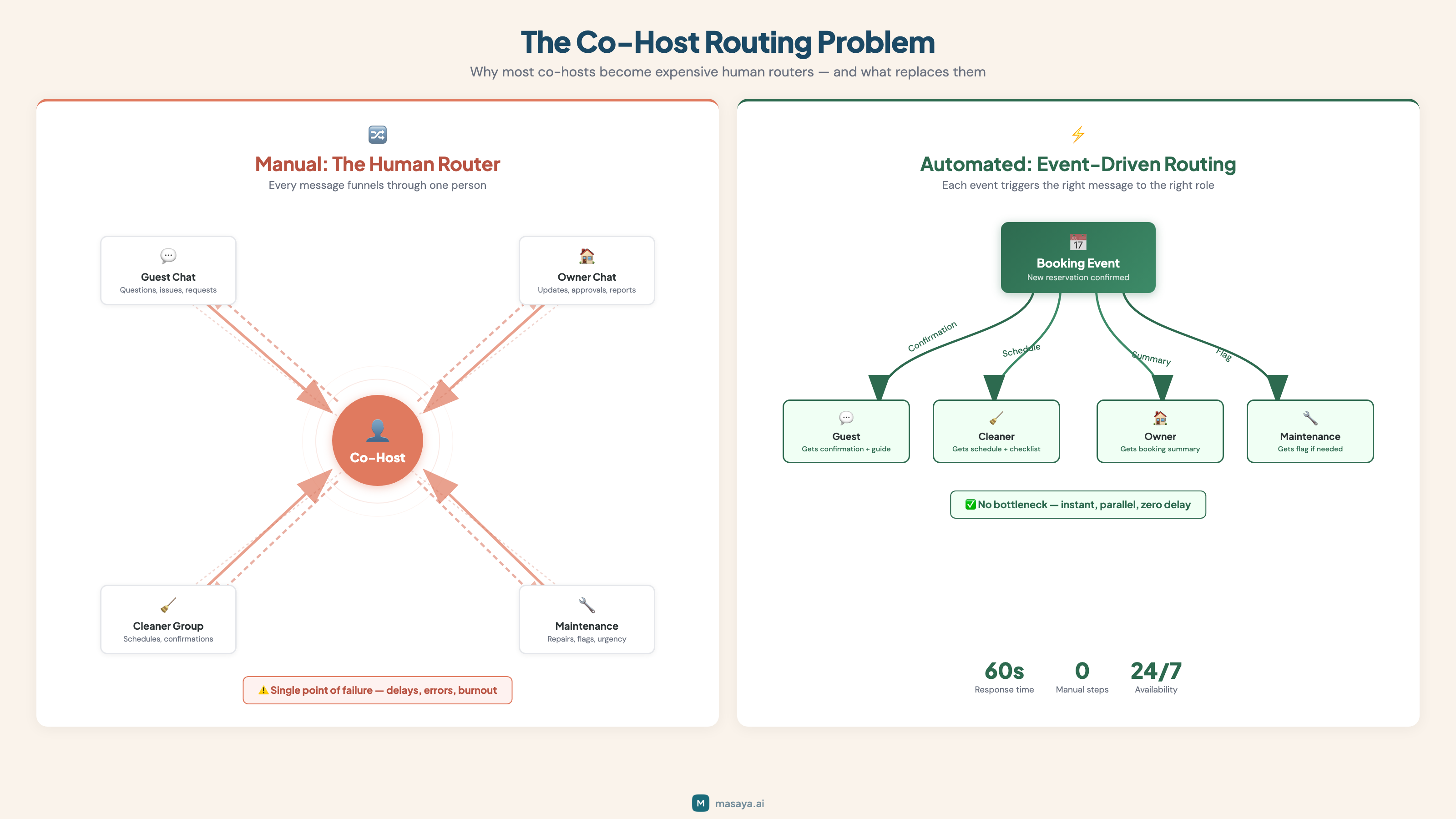
4. The Co-Host Becomes a Human Router
A lot of Bali hosts think they have a co-host problem.
What they actually have is a systems problem.
They hire a co-host at 15% to 25% of revenue because someone needs to keep the machine from breaking.
But look closely at what many co-hosts spend their day doing:
- forwarding messages between guest and cleaner
- repeating check-in details already available somewhere else
- updating owners manually
- translating operational noise into action
- chasing confirmations across different chats
That is not high-value hospitality work.
That is routing.
Sometimes necessary, yes.
But expensive.
If your co-host is acting like a switchboard operator between five WhatsApp groups, you are paying management fees to compensate for bad infrastructure.
The best co-hosts should be doing judgment work:
- handling exceptions
- managing guest experience
- solving edge cases
- protecting reviews
- improving operations
Not forwarding screenshots from Airbnb into WhatsApp all day.
5. You Hit the Scaling Cliff Faster Than You Think
Here is the math most hosts avoid.
At 3 properties, a strong operator can still hold the operation together manually.
Usually in the 15-20 hours per week range if bookings are steady and problems are manageable.
It still feels annoying.
But survivable.
At 5 properties, many hosts cross into 30+ hours per week.
That is burnout territory.
Not because the work got five times harder.
Because the coordination cost compounds.
Every extra property adds more:
- cleaner handoffs
- arrival windows
- maintenance exceptions
- guest questions
- owner updates
- last-minute changes
- compliance admin
And if your backbone is WhatsApp groups, the only way to keep up is to become more available.
That is the trap.
You are not scaling properties. You are scaling interruptions.
What Operationally Mature Hosts Do Differently
The smart hosts in Bali do not necessarily stop using WhatsApp.
They stop using it as the brain.
That distinction matters.
Operationally mature hosts understand one thing:
communication is not the system. It is the surface layer.
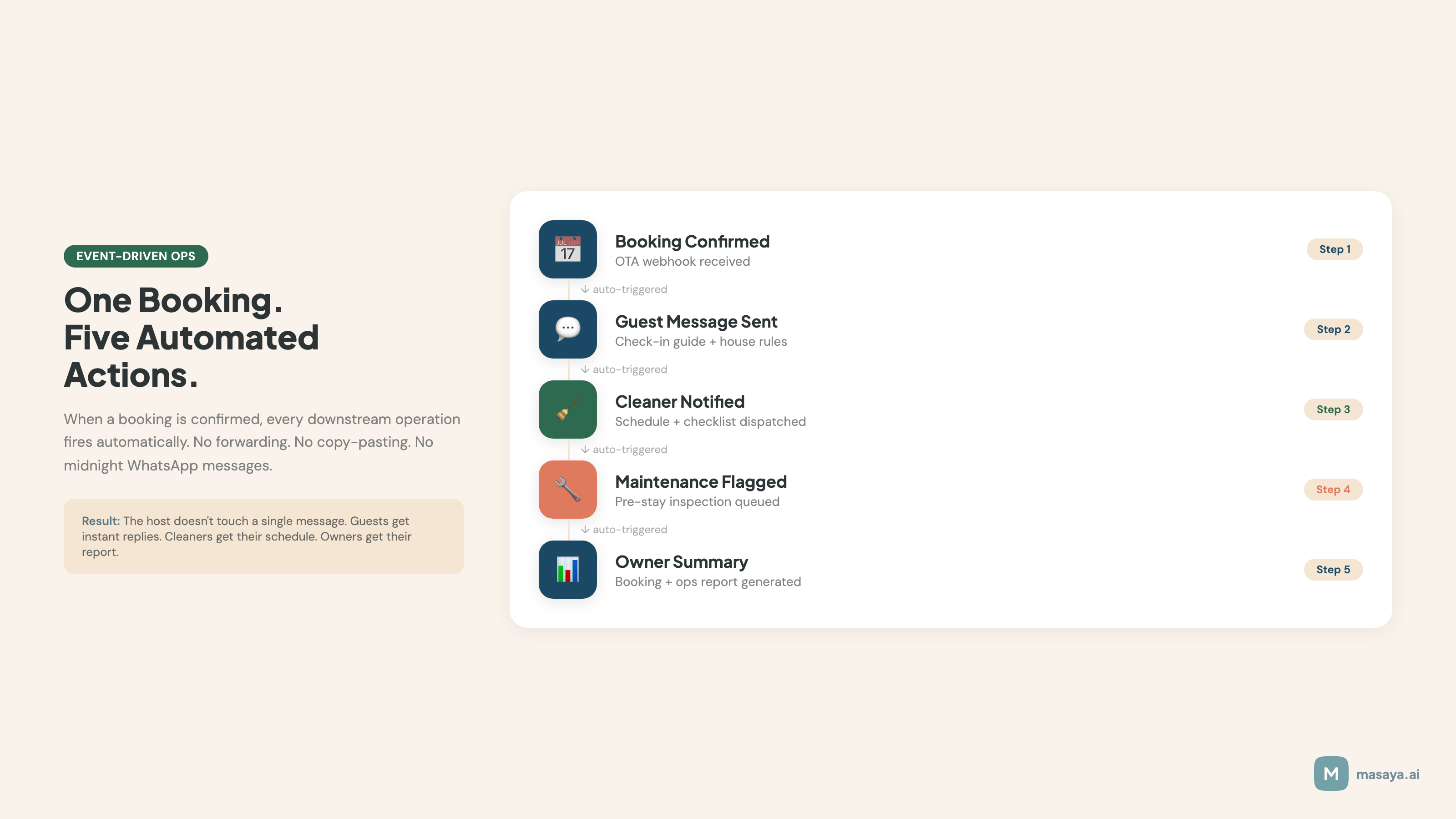
Underneath that surface, they build structured workflows where events trigger the next action automatically.
For example:
Booking event → role-based dispatch
A reservation comes in.
The cleaner gets the turnover window.
The ops lead gets the exception only if the booking creates a conflict.
The owner gets a summary, not the entire operational thread.
Calendar update → cleaning schedule sync
A guest checks out later than planned.
The cleaning schedule updates.
The next arrival risk is flagged.
Someone owns the exception.
Guest message → instant first response
A guest asks for check-in help or an airport transfer.
They get a useful reply immediately.
Not when the host wakes up.
Not after someone forwards it into the right group.
Operational completion → verified record
The clean is done.
Photos uploaded.
Task marked complete.
Time stamped.
Visible to the right people.
Not buried under 47 later messages.
That is the missing bridge in most Bali operations today:
guest communication and operational dispatch live in separate systems, or worse, in no system at all.
One side is guest-facing chat.
The other side is cleaners, vendors, co-hosts, and owners.
The operationally mature host connects those two worlds.
That is what eliminates the midnight scroll.
That is what reduces dependence on a human router.
That is what makes five properties feel manageable instead of chaotic.
The Cost of Not Fixing It
A lot of hosts think this is just an inconvenience issue.
It isn't.
It's a margin issue.
A review issue.
A lifestyle issue.
And increasingly, a compliance issue.
1. Burnout
The obvious one.
When every booking creates a stress response, hosting stops feeling like asset ownership and starts feeling like being on call forever.
2. Bad reviews from avoidable failures
Guests forgive small imperfections.
They do not forgive confusion.
If check-in is messy, if the villa isn't ready, if nobody replies fast when something breaks, the review suffers.
One cleaning miss outweighs a lot of nice amenities.
3. Revenue left on the table
Hosts talk a lot about occupancy.
They talk less about all the money lost because nobody responded fast enough or routed the request properly:
- airport transfer not confirmed
- early check-in missed
- late checkout never offered
- scooter rental inquiry forgotten
- in-stay recommendation moment wasted
The problem is not just missed messages.
It is missed moments.
4. Co-host fees covering for broken systems
Paying 15% to 25% to a co-host can make sense.
But if a meaningful chunk of that fee is funding manual forwarding and operational babysitting, you have a systems leak.
5. Compliance risk
As Bali tightens registration and rental compliance requirements, operators need clearer records, cleaner workflows, and less chaos around who did what and when.
Admin friction is manageable when systems are clean.
It becomes dangerous when compliance tasks are mixed into the same message soup as day-to-day chatter.
How to Start Reducing Your WhatsApp Dependency This Month
You do not need a giant tech stack tomorrow.
But you do need to stop pretending that more groups equals more control.
Start here:
1. Separate chat from ownership
For every recurring task, answer one question:
Who owns this when it appears?
Not who sees it.
Who owns it.
If you cannot answer that instantly, the task is living in the wrong place.
2. Stop sending calendar screenshots as the source of truth
A screenshot is a patch.
Not a system.
Your cleaners need live timing, not static images that go stale the second a booking changes.
3. Build role-based updates
Not everybody needs everything.
Your cleaner needs turnover details.
Your owner needs summary visibility.
Your guest needs confidence.
Your ops lead needs exceptions.
When everyone gets every message, nobody gets clarity.
4. Define exceptions versus routine events
Routine work should trigger automatically.
Humans should spend time on exceptions:
- guest locked out
- AC failure
- damage issue
- same-day turnover conflict
- VIP request
That is where human judgment belongs.
5. Measure where the chaos starts
Track three things for two weeks:
- Average response time to guest messages
- How many task follow-ups happen because someone missed the first message
- How many times you had to manually forward the same information between groups
That number is your ops tax.
Most hosts underestimate it badly.
If your operation only works because you personally remember everything, you do not have an operation yet. You have heroics.
The Smarter End State
The goal is not to kill WhatsApp.
The goal is to make sure WhatsApp is where communication happens, not where operations depend.
Smart Bali hosts still use familiar channels.
They just stop asking those channels to do jobs they were never built for.
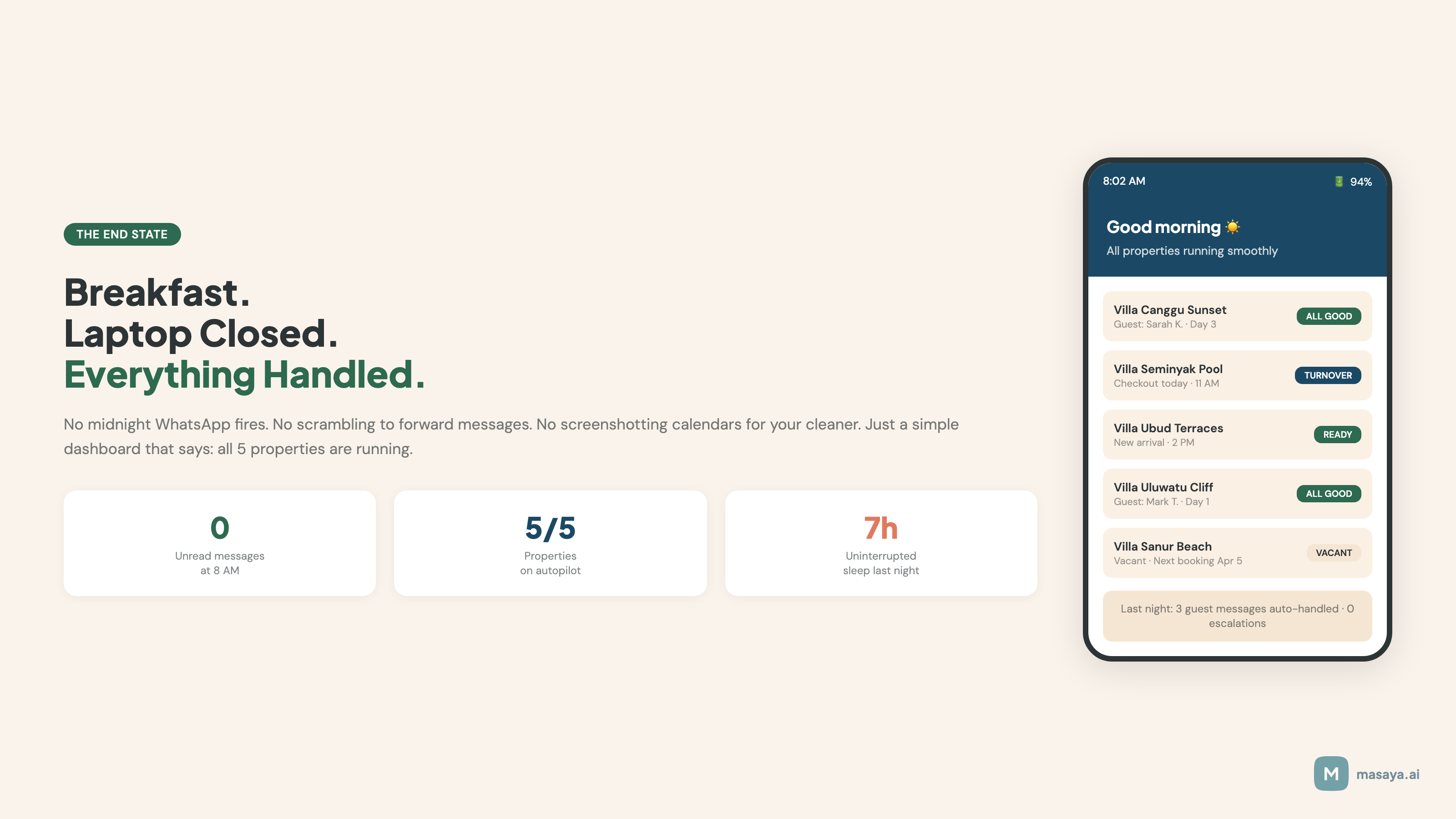
They move toward a setup where:
- booking events trigger the next action automatically
- cleaners get timing without chasing screenshots
- guests get useful replies in under 60 seconds — without the host touching anything
- owners get clarity without inbox chaos
- co-hosts handle judgment, not forwarding
- records exist outside the scrollback
The difference between a host who sleeps and one who doesn't is not the number of properties.
It is whether there is an intelligence layer doing the routing, responding, and flagging — so the host only hears from the system when a real decision is needed.
Not every WhatsApp ping.
Not every "is the cleaner done yet."
Just the things that actually require a human.
That is what operational maturity looks like in 2026.
Not more hustle.
Not more groups.
Better routing.
Better systems.
Better sleep.
If you're running your property through WhatsApp groups today, you're not behind.
You're normal.
Most hosts are.
But normal is exactly what starts breaking at the 3-to-5 property mark.
The hosts who get ahead are the ones who see the problem early:
the bottleneck is not communication. The bottleneck is coordination.
How many WhatsApp groups are running your property right now?