April 1, 2026 · 13 min read
The Complete Bali STR Automation Stack: What Top Hosts Use in 2026
By Masaya Team
Bali's STR market is being split in two right now.
On one side: hosts who cleared compliance and are building a real automation stack.
On the other: hosts still managing every guest message, cleaner handoff, and upsell manually — with a delisting risk they haven't fully dealt with.
The first problem is compliance.
By March 31, 2026, Bali villa operators listing on Airbnb and other major OTAs have been pushed to prove legal status or risk getting pulled offline. One widely cited estimate from VillaTax puts the risk at 40% of villas facing delisting if paperwork is not aligned. Several Bali legal and tax specialists have issued similar warnings.
The second problem is operations.
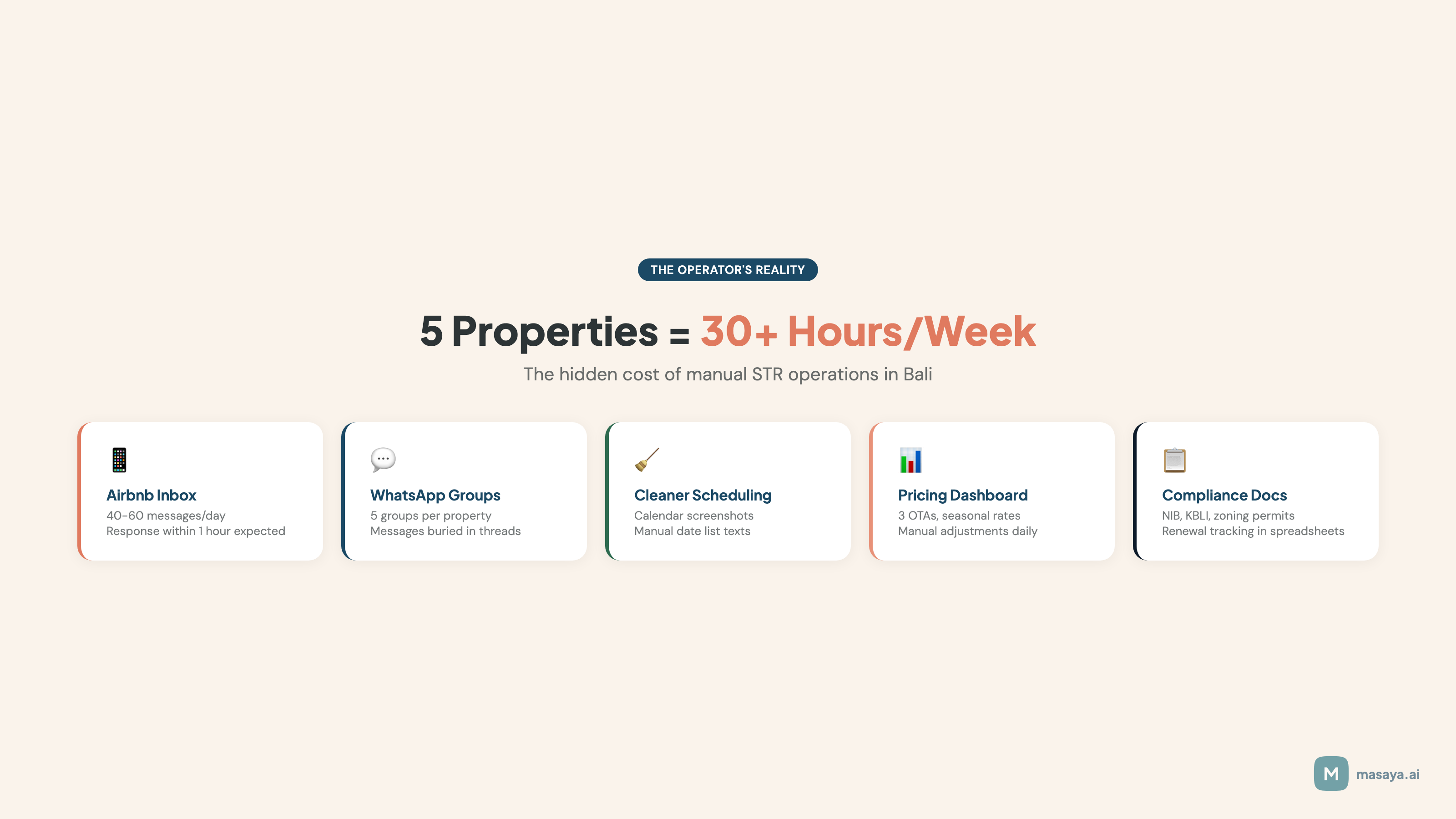
Once you cross roughly 5 properties, the old system breaks.
Guest questions. Cleaner coordination. Vendor dispatch. Check-in issues. Late checkout requests. Airport transfers. Compliance paperwork.
Individually, none of these tasks feels impossible.
Together, they turn into a 30+ hour/week job.
That is burnout territory.
And in Bali, the pain is sharper because many hosts are managing villas remotely from Australia, Singapore, Europe, or Jakarta. When your guest lands in Denpasar at 11:40 PM and your cleaner is asleep in Canggu, "I'll reply in the morning" is not an operating model.
The modern Bali host problem is not just too many messages. It is too many disconnected systems.
The real benchmark has changed
Guests do not compare your villa to another independent host anymore.
They compare you to the fastest, smoothest travel experience they had anywhere.
That is why response speed matters so much. Industry research cited across STR and hospitality tooling this year keeps landing on the same point: 65% of travelers expect a reply within one hour, while best-in-class operators are driving response times under 60 seconds.
Not because they are personally glued to their phones.
Because their systems are.
That is the big shift.
The best Bali hosts are no longer "working harder."
They are building an automation stack that handles the repetitive work, routes the operational work, and leaves the human team to solve the exceptions.
The 5 layers of a working Bali STR automation stack
A real automation stack for Bali in 2026 has five layers:
- Guest messaging — fast, accurate, contextual replies across the entire stay
- Cleaning and turnover coordination — making sure the unit is actually ready on time
- Pricing and calendar control — keeping rates and availability competitive without manual babysitting
- Compliance and documentation — licenses, legal status, permits, records, and the local admin burden
- Upsell capture — turning guest demand into revenue instead of loose chat threads
Most hosts have some of these.
Very few have them connected.
That is the difference.
Layer 1: Guest messaging that works in the real world
This is where almost every Bali operator feels the pain first.
Most guest questions are repetitive:
- Check-in instructions
- Wi-Fi password
- House rules
- Scooter parking
- Airport pickup
- Best cafes nearby
- Can we check out late?
The problem is not that hosts cannot answer these.
The problem is that answering them manually, over and over, destroys focus.
And in Bali, guests and local teams naturally drift to WhatsApp because that is where real-life coordination happens. Guests use it. Drivers use it. Villa managers use it. Maintenance vendors use it. That makes WhatsApp the de facto operations layer whether a PMS likes it or not.
What top hosts use here
The most common tools in this layer today are:
- Hospitable
- Host Tools
- Guesty
- iGMS
Each can help with templated messaging, scheduled triggers, inbox workflows, and some degree of automation.
They are useful.
But the gap is obvious once a Bali operation gets a little messy.
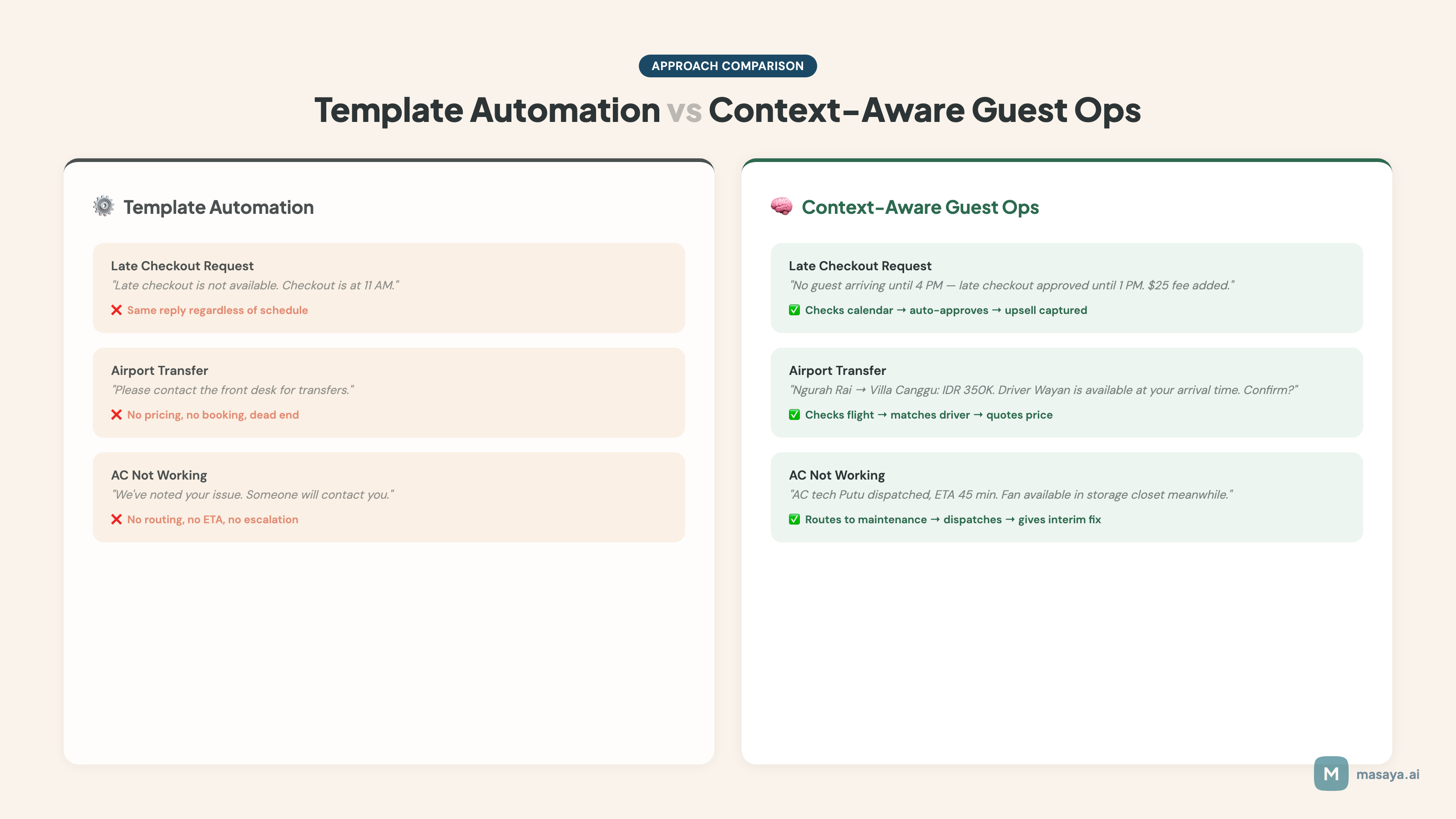
A guest message is rarely just a message.
It is often the start of an operational chain:
- "Can we check in early?" → cleaner timing issue
- "The AC in the second room is not cooling" → maintenance dispatch
- "Can you arrange a driver from the airport?" → vendor coordination + payment + confirmation
- "Can we stay until 4 PM?" → calendar, pricing, and cleaner timing all at once
That is why the best messaging setup is not just fast.
It is context-aware.
It should know the property. It should know the booking window. It should know the turnover schedule. It should know when to answer automatically and when to escalate.
A good host automation system does not send canned responses faster. It makes better decisions faster.
What "done right" looks like
A strong Bali messaging layer in 2026 should be able to:
- Respond in under 60 seconds to common guest questions
- Pull the right property-specific answer automatically
- Route urgent issues to the right human immediately
- Keep responses natural, not robotic
- Handle timezone gaps without leaving guests hanging
If you still need to personally answer every 10 PM arrival message, you do not have automation.
You have an expensive notification system.
Layer 2: Cleaning coordination that prevents bad reviews
A lot of hosts think their biggest issue is guest communication.
It usually is not.
It is the handoff between guest communication and operational execution.
The guest thinks they are asking a simple question.
But the real question is often:
Is the villa actually ready?
That is why one cleaning miss outweighs a dozen amenities.
You can have a beautiful pool, a premium coffee setup, and a perfect location.
If the guest arrives and the property is still being cleaned, the review damage is immediate.
What top hosts use here
For this layer, Turno is the most recognizable specialist tool. Many hosts also use cleaning workflows inside Hospitable, Guesty, or their PMS. Some still run everything through WhatsApp groups and manual screenshots of calendars.
That works at 1 or 2 properties.
It breaks at 5.
Because the issue is not just assigning a clean.
It is syncing:
- checkout time
- next arrival time
- inspection status
- linen issues
- maintenance flags
- delay alerts
What "done right" looks like
A working turnover layer should:
- Auto-assign cleans when bookings change
- Alert cleaners to back-to-back turnover pressure
- Confirm clean completion with proof
- Trigger inspection or maintenance if an issue is logged
- Update the guest-facing status so arrivals are not promised impossible times
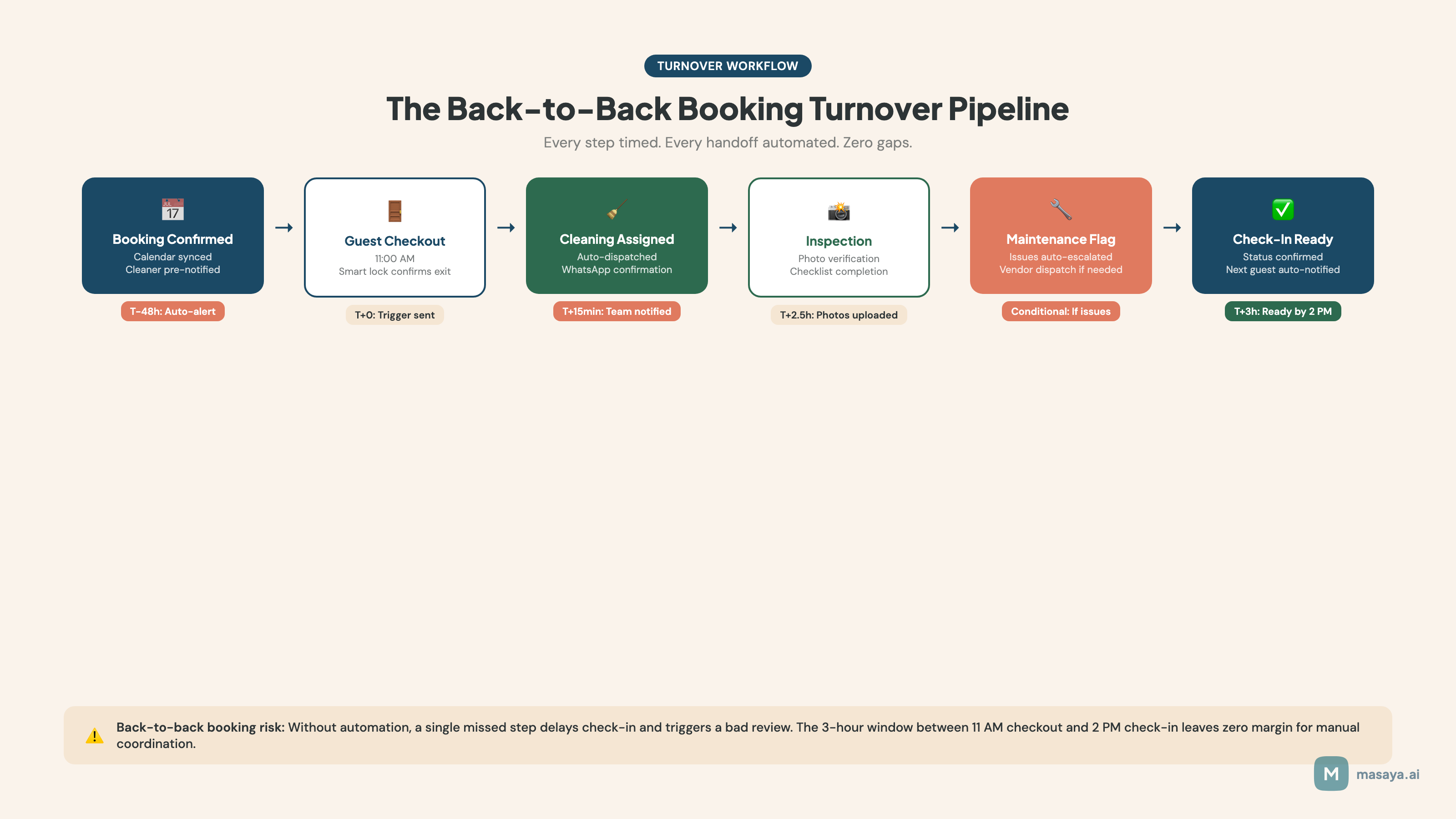
The best operators do not just automate the cleaner notification.
They automate the handoff logic.
That is what keeps a 3 PM check-in from becoming a 3-star review.
Layer 3: Pricing and calendar control
This layer is more mature than the others — most serious operators are already here.
Tools like PriceLabs, Beyond, or pricing modules inside larger PMS platforms handle the core dynamic pricing logic well.
But automation is not only about saving time.
It is also about protecting margin.
When a host is buried in messaging and turnovers, pricing becomes reactive.
They forget to tighten minimum stays for peak periods. They miss demand spikes. They leave money on the table during shoulder weeks.
What "done right" looks like
A healthy pricing layer should:
- Sync across Airbnb and Booking.com without manual intervention
- Reflect seasonality and local demand shifts automatically
- Protect occupancy without racing to the bottom
- Surface gaps that can be filled with targeted offers or upsells
The harder part is not the tool.
It is connecting this layer to the rest of the guest journey.
If your pricing tool knows the calendar is tight but your messaging system still promises flexible check-in and late checkout to everyone, your stack is fighting itself.
Layer 4: Compliance and documentation
This is the layer Bali hosts can no longer treat as back-office admin.
It is now operational.
The 2026 crackdown made that painfully clear.
Between new KBLI alignment questions, OSS registration complexity, zoning checks, NIB documentation, and local licensing requirements, foreign owners in particular are finding out that a villa can be beautiful, booked, and still operationally fragile.
A common failure point is not fraud.
It is mismatch.
Wrong business classification. Wrong legal entity structure. Incomplete OSS records. Paperwork that exists, but not in the form a platform or advisor expects.
What "done right" looks like
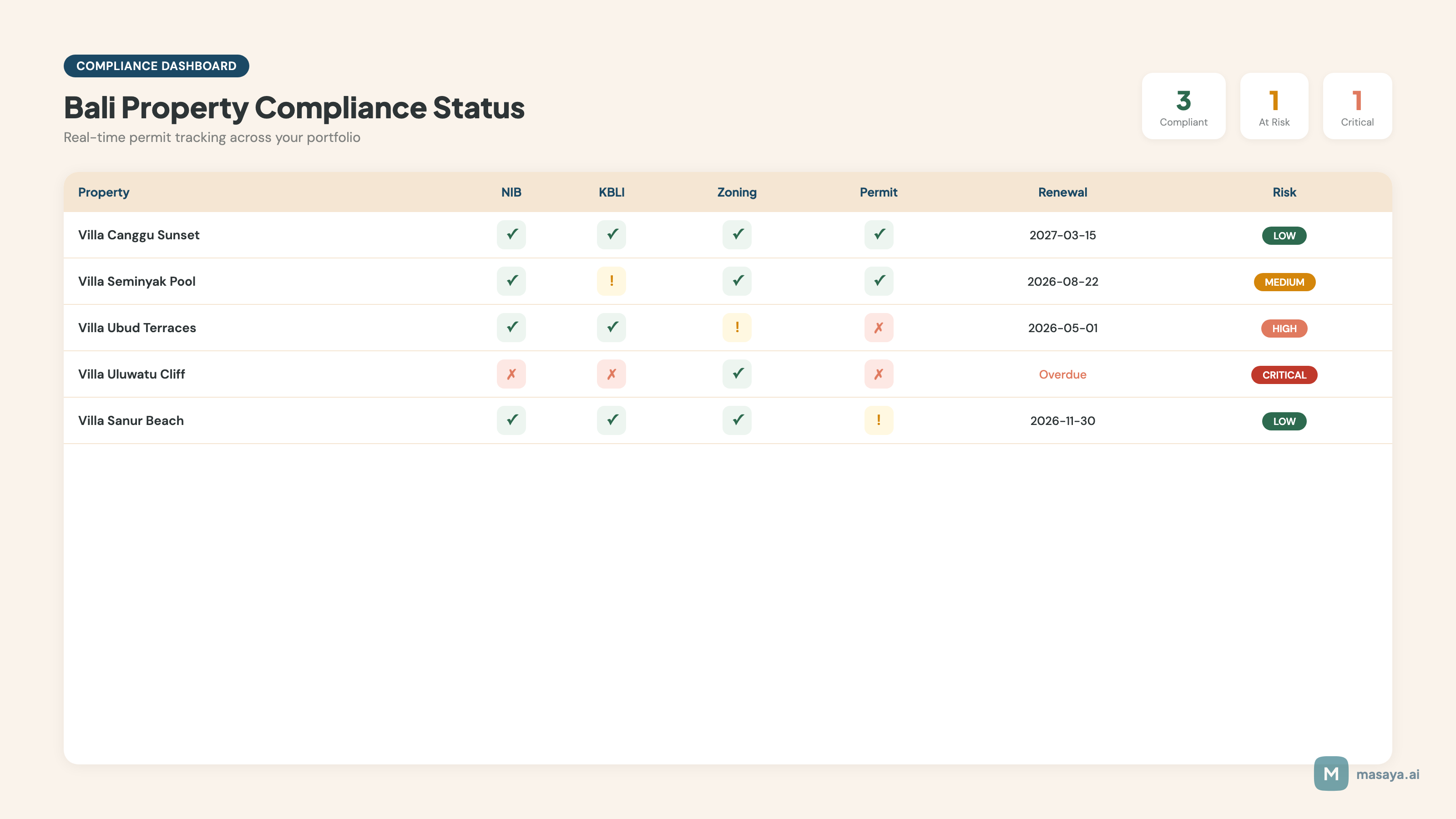
A real compliance layer should give you:
- One source of truth for legal documents
- Clear status by property, not just by company
- Renewal reminders before deadlines hit
- Property-by-property visibility into licensing gaps
- Fast retrieval when Airbnb, partners, or advisors ask for proof
In Bali in 2026, compliance is not a legal side quest. It is part of your operating stack.
The operators who survive this cycle will not be the ones with the prettiest listings.
They will be the ones with clean paperwork and clean workflows.
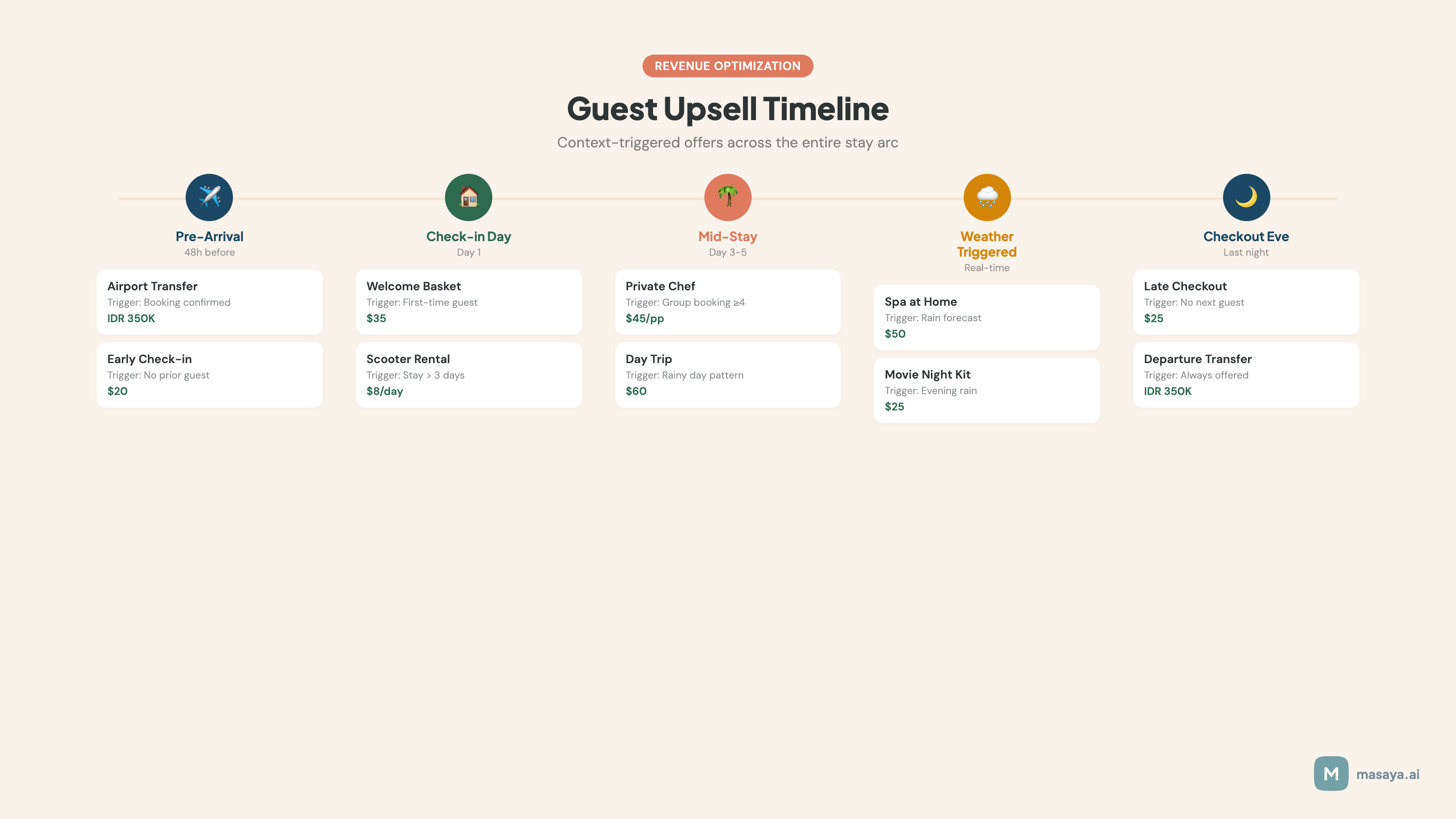
Layer 5: Upsell capture
This is the most underbuilt layer in the entire STR stack.
And it is where Bali hosts leave real money on the table.
Because demand is already there.
Guests ask for:
- Airport transfers
- Early check-in
- Late checkout
- Scooter rental
- Private chef
- In-villa massage
- Day tours
- Floating breakfast
- Extra cleaning
The problem is not offer creation.
The problem is capture.
In most operations, upsells live inside random chat threads.
A guest asks. The host replies late. The driver is not confirmed. The cleaner was not told. Payment is awkward. Nobody tracks what converted.
That is not a revenue system.
That is improvisation.
What "done right" looks like
A functioning upsell layer should:
- Trigger offers at the right moment in the stay
- Match offers to actual guest context
- Route fulfillment to the right vendor
- Confirm delivery automatically
- Track acceptance and fulfillment rates
The smart hosts are not trying to "sell harder."
They are making the right offer at the right time, with less friction.
For example:
- 3 days before arrival → airport pickup
- Morning of checkout eve → late checkout offer
- Rainy afternoon forecast → in-villa massage or chef experience
- Long stay midpoint → refresh clean upsell
The gap nobody talks about: these layers do not talk to each other
This is the real issue in Bali.
Not that tools do not exist.
They do.
The problem is that they are still mostly separate systems:
- Messaging in one place
- Cleaning in another
- Vendors in WhatsApp threads
- Pricing in another dashboard
- Compliance in Google Drive
- Upsells buried in chat history
That fragmentation creates three expensive problems.
1. The guest gets a fast reply, but the operation stays slow
A guest hears "Yes, early check-in should be possible."
But nobody checked whether the cleaner can actually finish in time.
2. Your team becomes human middleware
Someone is constantly copying information from one system into another.
Cleaner ETA into the guest chat. Guest arrival update into the cleaner group. Vendor confirmation into Airbnb. Compliance doc into a partner email.
That person is not managing the business.
They are routing data.
3. Remote owners carry invisible anxiety all day
This is the part a lot of founders and software companies miss.
The pain is not just the labor.
It is the constant low-grade stress of knowing that your operation depends on your phone being charged, your WhatsApp working, and you being awake when something breaks.
What a connected stack actually looks like
A connected Bali automation stack in 2026 should behave like this:
- The guest asks for early check-in
- The system checks the calendar and turnover status
- If the clean can be accelerated, the cleaner gets the right update
- If it cannot, the guest gets the right expectation immediately
- If there is a paid early access option, the offer is presented cleanly
- The host only gets pulled in if the situation falls outside the rules
That is the model.
Not "automate messages."
Automate decisions, routing, and follow-through.
The host should spend time on:
- owner relationships
- revenue strategy
- property standards
- exception handling
- growth
Not on copying the check-in code into three different chats.
The best automation stack is not the one with the most tools. It is the one with the fewest broken handoffs.
What Bali hosts should do next
If you are reading this while managing 2 to 10 properties, do not try to overhaul everything in one week.
Start with an audit.
Ask these 5 questions
-
Where do guest conversations actually happen? Not where you wish they happened. Where they happen.
-
How many operational tasks still require manual forwarding? If you are constantly relaying messages between guest, cleaner, and vendor, that is the bottleneck.
-
What percentage of guest questions are repetitive? If most of your inbox is the same 10 questions, that is an automation opportunity.
-
Can your team prove a property is check-in ready without texting three people? If not, your turnover layer is weak.
-
How many upsell requests are currently invisible in reporting? If the answer is "most of them," you do not have an upsell system yet.
Then fix the stack in this order
- Messaging first — because response speed touches reviews immediately
- Turnover handoffs second — because cleaning misses are brutally expensive
- Upsell capture third — because this can fund better operations
- Compliance visibility fourth — because Bali is no longer forgiving messy paperwork
- Deeper integration last — only after the workflows are clear
Do not buy more software just to feel organized.
Map the workflow first.
Then decide which layer needs a tool, which needs a process, and which needs a bridge between the two.
Final thought
The top Bali hosts in 2026 are not winning because they found one magical platform.
They are winning because they stopped treating guest messaging, cleaning, vendor dispatch, compliance, and upsells as separate admin tasks.
They built a system.
That system replies faster. It makes fewer promises it cannot keep. It protects reviews. It protects margin. And most importantly, it gives the host their life back.
If your current setup still depends on you being the bridge between every moving part, you do not need more hustle.
You need a better stack.
What does your current Bali STR stack look like right now?
If you're building toward something more connected — we're working on exactly this. Early access is open.